
Final article in the series. We drew Aboulafia’s order and watched a striking symmetry appear. That symmetry has a precise name.
The symmetry of a polygon
Take a regular polygon with n sides — an equilateral triangle, a square, a regular pentagon, and so on. Ask: in how many ways can you pick it up and set it back down so that it looks exactly the same? You can rotate it, by any multiple of 360°/n — that is n rotations. And you can flip it over across an axis of mirror symmetry — a regular n-gon has exactly n such axes. Altogether, 2n motions leave it unchanged.
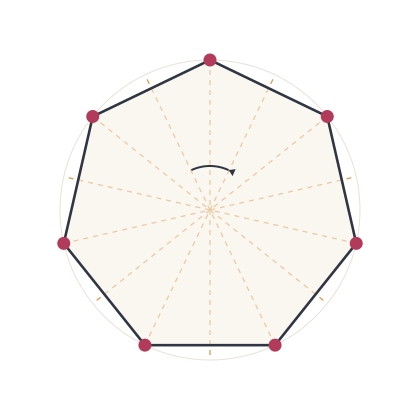
That collection of 2n symmetries is a mathematical object in its own right, called the dihedral group, written Dₙ. It is the symmetry of the regular n-sided polygon: n rotations and n reflections.
The name is worth unpacking. Dihedral comes from the Greek di-, “two”, and hedra, “seat” or “face”. A dihedron is a figure with two faces — think of a flat polygon as an infinitely thin solid, with a front face and a back face. The dihedral group is the group of symmetries of that two-faced figure. Keep that “front and back” in mind; we will meet it again.
Why the Aboulafia graph has exactly this symmetry
Recall how the graph is built: the n! words sit on a circle in Aboulafia’s order, and each is joined to its reversal. In a paper with Or-Hai Benjo, we prove that this figure has exactly the dihedral symmetry Dₙ — and the two generators fall straight out of Zaks’s recursive recipe.
The rotation — the wheel turns. The recursion cuts the order into n identical blocks, each a copy of the order for n−1 letters, whose starting points are the successive powers id, ρ, ρ², …, ρⁿ⁻¹ of a single n-fold cyclic step ρ. Applying ρ sends every block to the next — it turns the whole wheel by one block, exactly 360°/n. There are the n rotations.
The reflection — the palindrome. The recipe of reversals that builds the order is a palindrome: it reads the same forwards and backwards. And because every reversal undoes itself, walking the cycle from the other end simply reverses the whole sequence of words — a mirror. There is the reflection.
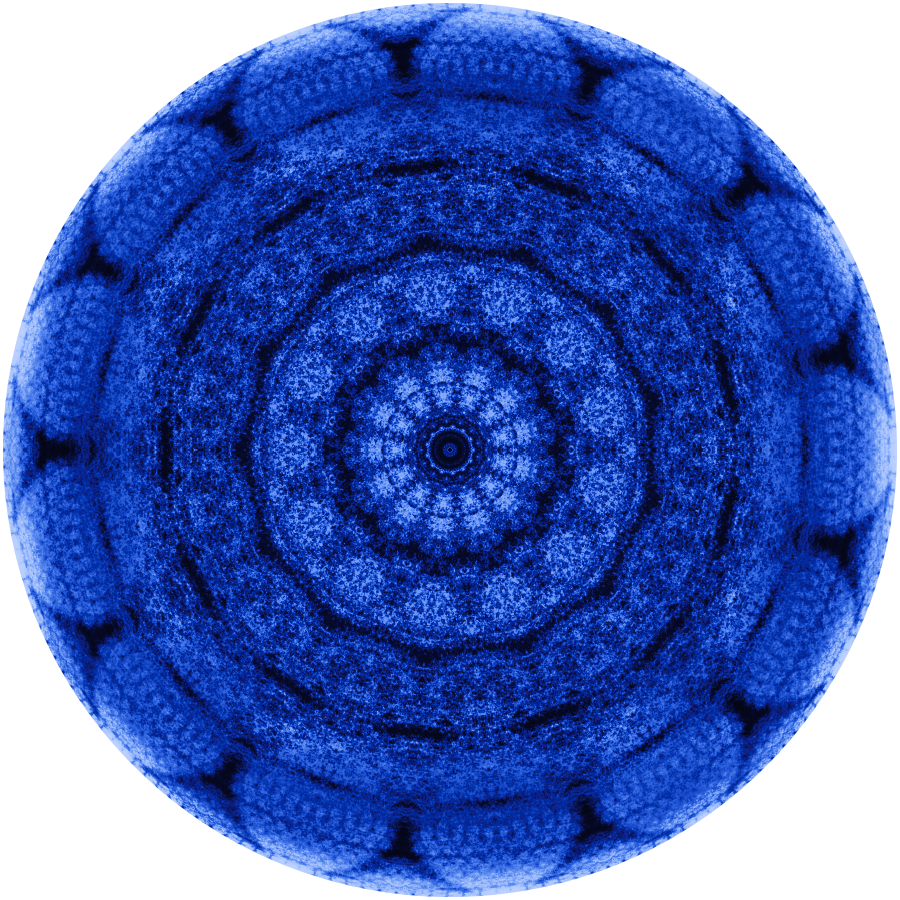
A rotation of order n and a mirror: together they generate Dₙ. The harder half of our paper then shows these two are the only symmetries — the Aboulafia graph has exactly the symmetry of the regular n-gon, no more and no less.
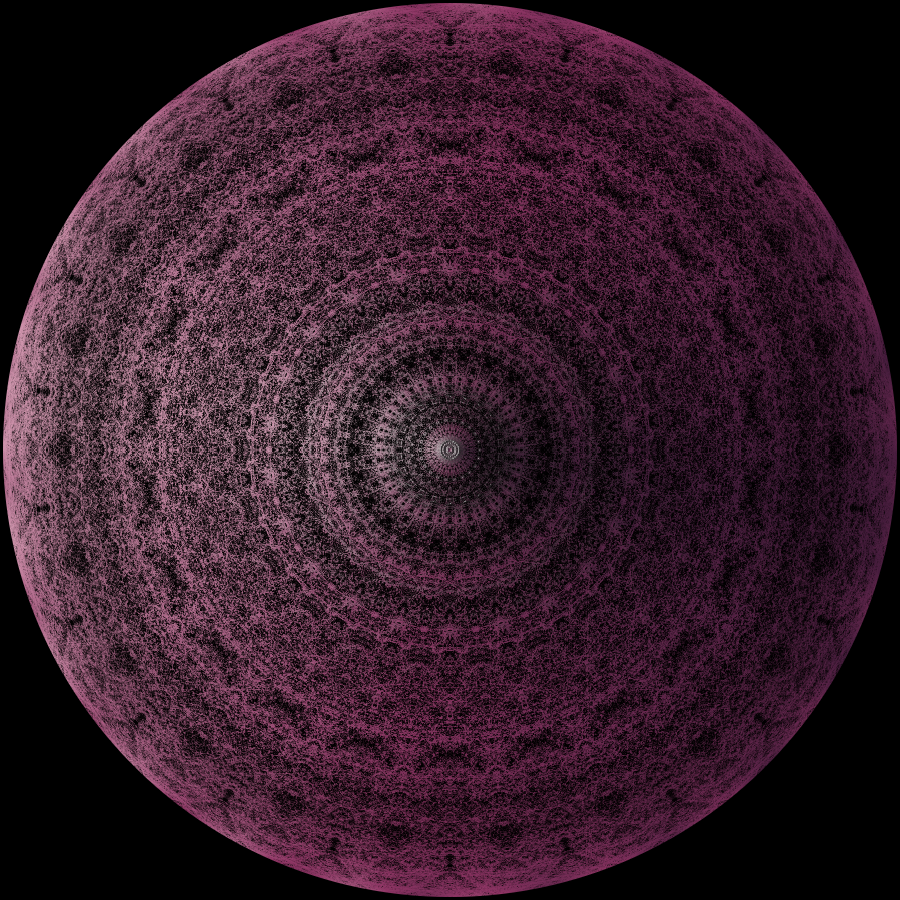
You can see it directly — count the repeated motifs around the rim, and notice that each motif is itself mirror-symmetric:
The same law: mandala, kaleidoscope, flower
Dihedral symmetry is not exotic. It is one of the most common shapes the world reaches for whenever it arranges parts around a centre.
A mandala — from the Sanskrit maṇḍala, simply “circle” or “disk” — is built, in Buddhist and Hindu traditions, on rotations and reflections about a centre. Its structure is dihedral.
A kaleidoscope — coined in 1817 from the Greek kalos (“beautiful”), eidos (“form”) and skopein (“to look at”): “the seeing of beautiful forms” — produces its images with mirrors, reflecting a small pattern again and again around a centre. Its images are dihedral by construction.
The corolla of a flower — its ring of petals — repeats one petal n times around the centre, each petal a mirror of its neighbours. Dihedral again.
Cultural, optical, biological — three utterly different worlds, and the same group Dₙ underneath all of them. One is tempted to see in dihedral symmetry something like a meta-law of organisation: the form that matter and mind alike fall into whenever they order themselves around a still centre — in a crystal, a petal, a rose window, a mandala. The Aboulafia graph simply adds one more member to that family, grown not from matter but from the permutations of letters.
A wheel, the same front and back
The Sefer Yetzirah, the ancient book at the root of this whole tradition, speaks of the galgal — the wheel — and of panim v’aḥor, a phrase usually translated “forwards and backwards.”
And here our theorem says something precise. Panim means face; aḥor means back. The dihedral reflection we proved is exactly the flip that exchanges the two faces of the wheel — the two faces of the dihedron. So the wheel is not only the same forwards and backwards in the ordinary, directional sense: it is literally the same front and back. What tradition rendered loosely as a direction, the mathematics restores to the letter — a wheel whose face and back are one and the same.
The wheel is the rotation; front and back, the same either way, is the reflection. And the words echo the mathematics once more: the recipe of reversals behind the wheel is a palindrome, a sequence that reads the same in either direction — and that palindrome is precisely the mirror. Aboulafia’s letter-wheel, turned and reversed, is a dihedral object; and the graph proves it, letter for letter, n copies to the turn.
The two languages even close on the same word. Dihedral means two faces — from the Greek di-, two, and hedra, face. And panim v’aḥor — face and back — is two faces as well. It is as if the Sefer Yetzirah, in that single phrase, had already named a dihedral symmetry: a symmetry of two faces, a front and a back that turn out to be one.
A 13th-century Kabbalist set out to turn the letters until ordinary meaning dissolved. Seven hundred years later, drawn on a circle, his wheel comes back to us in the shape of a mandala, a kaleidoscope, a flower — the same forwards and backwards. Perhaps that shape is what he was turning toward all along.
Images © 2026 Yehonathan Sharvit. Free to share with credit and a link.